Yeah! I'm finish!
here is our poster for present... Actually, i don't like the way teacher ask us to present via poster. It was very bored. Anyway, it wasn't too bad, I can looking around and see other project.


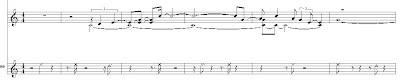


Low voice
|
General Thai music voice
|
High voice
|
ดฺ (Low Dole)
|
ด (Dole)
|
ดํ (High Dole)
|
รฺ (Low Re)
|
ร (Re)
|
รํ (High Re)
|
มฺ (Low Me)
|
ม (Me)
|
มํ (High Me)
|
ฟฺ (Low Fa)
|
ฟ (Fa)
|
ฟํ (High Fa)
|
ซฺ (Low Sol)
|
ซ (Sol)
|
ซํ (High Sol)
|
ลฺ (Low La)
|
ล (La)
|
ลํ (High La)
|
ทฺ (Low Si)
|
ท (Si)
|
ทํ (High Si)
|
1
|
2
|
3
|
4
|
5
|
6
|
7
|
8
|
1234
|
1234
|
1234
|
1234
|
1234
|
1234
|
1234
|
1234
|
OCR
There is several ways to use image processing on OCR program, but we decided to use these 2 algorithms.
1. Blob Coloring
We are using Blob coloring technique for OCR. Once an image has been segmented into as number of regions using thresholding or another method, it is often useful to identify each of the connected components in the image. The process of assigning each distinct region unique identifiers is called blob coloring. Blob coloring program uses a simple recursive search algorithm to find all points connected a starting point. Several program options enable the user to search for white objects on black backgrounds or vice versa, and vary the definition of "connected" to use 4 neighbors or 8 neighbors. (But we use 4 neighbors)
Blob coloring algorithm has two passes. In the first pass, colors are assigned to image pixels by using 4 neighbors, L-shaped mask. Color equivalences are established and stored, when needed. In the second pass, the pixels of each connected region are labeled with a unique color by using the color equivalences obtained in the first pass.
After we have the color equivalences of all character, we draw the crop line of each character for define the character.
2. Matching with database
For the database character, we have 7 character of each tone and define the ration of width and height and group them by the result. (More than 1, 0-1, less than 1) Because it can simplify for compare with the scanned text.
After we have cropped character, for each character we find the ratio of width and height. When we have the ratio of scanned character, then we match the character with the database character in the same group of ratio. (From this algorithm, we can eliminate some character from database) After that, we use sum square error for recognize the most similar character between scanned texts and database.
Introduction
Nowadays, Thai musical Technologies are not released much, although many innovations are created, but most of them do not involve about Thai Cultural. Thus for promoting Thai Music to be known widely, we develop software for reading Thai Music Notation to facilitate users.
This project is created to facilitate for users who want to learn about Thai Music. Thai Music Notations is presented in form of Thai Characters. For program processing, program gets input in form of image file from scanning actual notations. After that, it will passed through Optical Character Recognition (OCR) to transform data to characters and display especially inform of sound by generating e and instruction sound to play the note following the songs.
OCR is a program that is developed to transform from images to characters. English version of OCR can recognize efficiency about 99%, but in Thai version still low integrity. This project is applied to be more useful apart from reading only Thai characters.
Objective
1. To apply the knowledge about OCR to implement project
2. To develop software to reading Thai Music Notation
3. To conserve Thai Cultural with using technologies
Thai Music Notation Reader
Advisor Prof. Kurt Rudhal
| Miss Patama Ranchune | Student ID 49270621 |
| Miss Sitanan Nipatvaranan | Student ID 49270650 |
Thai Music Notation Reader is a program which is implemented for generating Thai Music Notation and transforms to sound. Initially,image processing is utilized in reading Thai Music Notation using OCR which will compare generated notations with the music notations in database.Afterthat, Thai Music sound which matchs with the notation will be played.
To explain Thai Music Notation Reader, we seperate basic information into 3 parts which are easy to understand.
§ Thai Music Notation Behavior
- Thai Music Notations are represented by 7 Thai characters. --> ด ร ม ฟ ซ ล ท (Do Re Me Fa Sol La Ti)
- Quadruple meter (4 accents) are used in separating.
- There are 3 ranks of sound speed (fast, normal and slow)that can define by small cup-shaped symbols called "Ching" accent.
- The octave tone defined by dot(.) behind and below the characters.
§ Program Functions
- Read notation in sequence using OCR.
- Define sound speed.
- Selects the musical sound.
- Selects the language (Thai/English)in user interface.
§ Optional
- Be able to use with USB MIDI controller.
- Be able to play serveral musics simutaneously.


